

Sometimes engineers want to check if a table exists before writing or merging data. To do this, they often loop through a list of tables and query information_schema.tables.
❌ The Anti-Pattern: Full Catalog Scans in a Loop
Here is the code that can causes pipelines to hit metastore rate limits or fail entirely:
# This forces a full scan of the entire metastore catalog on every execution
spark.read.table("catalog.information_schema.tables") \
    .filter((col("table_schema") == my_schema) & (col("table_name") == my_table))
The Technical Bottleneck
The information_schema is built for wide-scope catalog introspection—such as auditing, broad governance mapping, or checking metadata across an entire environment at once.
When you chain a .filter() in Spark after loading information_schema.tables, there is zero predicate pushdown to the underlying metastore database. The metastore is forced to enumerate and return every single object inside that catalog to the Spark engine, leaving Spark to do the actual row filtering client-side in memory.
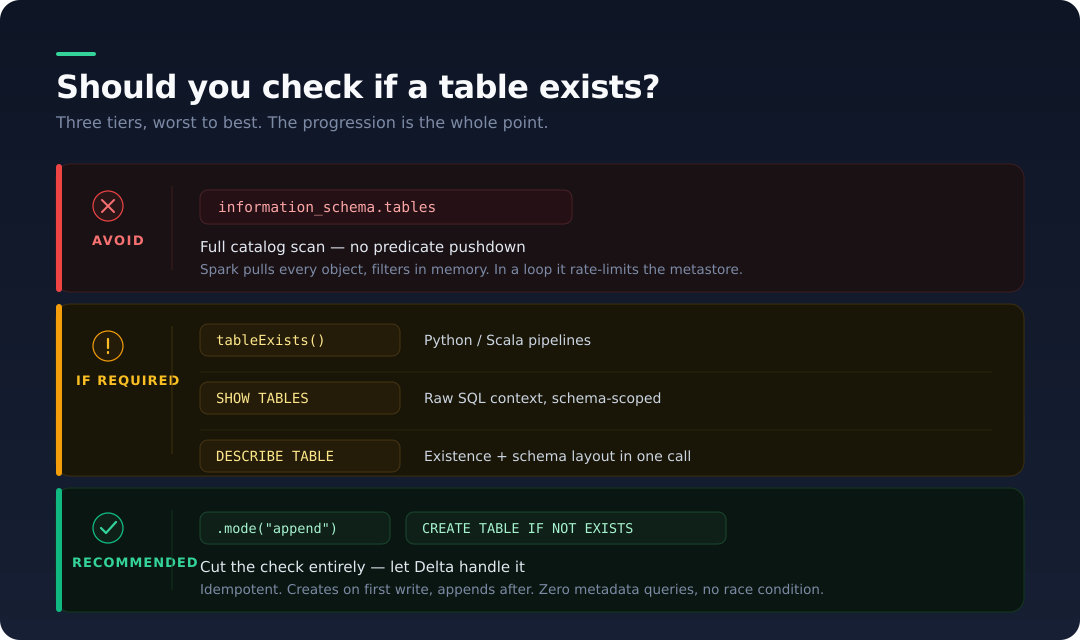
The Solution: Use True Point-Lookup APIs
If you only need to verify the existence of a single table, you must bypass catalog-wide views and target a single metadata record directly.
Option 1: Programmatic Check via tableExists() (Recommended)
For pure automation pipelines, the native Spark catalog API handles this efficiently without compiling a heavy relational query plan. It hits a single metadata record instantly.
# Target a single metadata record directly
exists = spark.catalog.tableExists("catalog.schema.table")
Option 2: SQL Scoped Check via SHOW TABLES
If you are working strictly within raw SQL strings, limit your query scope using an explicit schema filter and a wildcard match rather than querying the entire catalog.
-- Fast, schema-scoped point lookup
SHOW TABLES IN catalog.schema LIKE 'table_name';
Option 3: Structural Validation via DESCRIBE TABLE
Often, you don’t just need to know if a table exists—you need to ensure its current column layout matches what your engine expects. You can leverage structural evaluation enclosed in an exception block.
from pyspark.sql.utils import AnalysisException

# Validates existence and structure simultaneously
try:
    spark.sql("DESCRIBE TABLE catalog.schema.table")
    exists = True
except AnalysisException:
    # Catch AnalysisException specifically. A bare 'except' turns
    # permission errors and transient timeouts into false "table missing" signals.
    exists = False
When Do You Actually Need information_schema?
If your objective is broad discovery—like mapping end-to-end data lineage across the entire workspace—using information_schema is completely appropriate. However, you should follow this single operational rule: Read it exactly once at the top of the job, cache it, and filter from memory.
# Execute exactly one metastore scan total
all_tables = spark.read.table("catalog.information_schema.tables").cache()

# Filter from the cached memory layer as many times as needed
bronze_tables = all_tables.filter(col("table_schema") == "bronze")
silver_tables = all_tables.filter(col("table_schema") == "silver")
The Ultimate Fix: Cut the Check Entirely
Pre-flight existence checks usually exist because a pipeline doesn’t know whether to create a new table or append to an existing one. If you are using Delta Lake, Delta already solves this for you.
Using .mode("append") will automatically create the table on the first write, and seamlessly append to it on every run after:
df.write \
  .format("delta") \
  .mode("append") \
  .saveAsTable("catalog.schema.target_table")
SQL pipelines get the exact same guarantee from a single DDL line at setup:
CREATE TABLE IF NOT EXISTS catalog.schema.target_table (
    id INT,
    data STRING,
    event_time TIMESTAMP
) USING DELTA;

INSERT INTO catalog.schema.target_table SELECT * FROM staging_view;
The Bottom Line: When you see an existence check before a write in a code review, ask what it’s actually guarding against. Usually, there’s no good answer—and removing it will save your metastore from a world of hurt.