

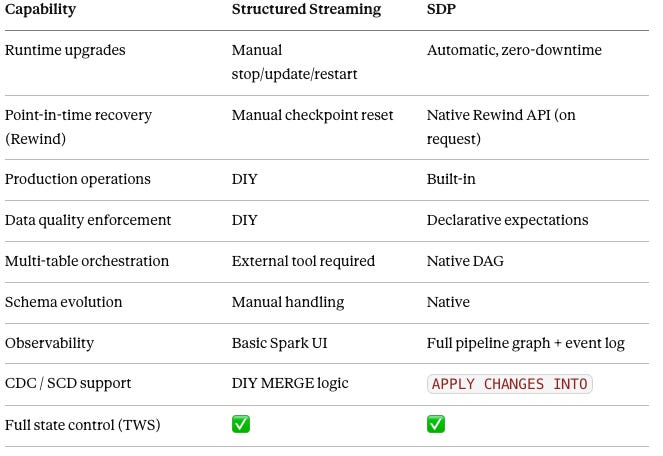
Structured Streaming gives you raw power. Spark Declarative Pipelines (SDP) gives you that same power with a production-grade operations layer built on top, right out of the box.
I’ve spent the last 5 years designing and running thousands of streaming jobs. Here’s how I actually see the tradeoff.

1. Zero-Downtime Runtime Upgrades
This is one of the most under-appreciated advantages of SDP. With a classic Structured Streaming job on regular compute, a runtime upgrade looks like this:
Stop the job (downtime begins)
Update the runtime version on the cluster
Restart the job
Wait for startup and checkpoint recovery
Every upgrade becomes a scheduled maintenance window. Because of this, teams constantly defer them, accumulate technical debt, and eventually face a forced migration under pressure.
With SDP, your pipelines are versionless. Databricks manages the runtime lifecycle for you. New compute spins up in the background, your pipeline migrates over automatically, and there’s no restart sequence to plan around. If you are running a few dozen streaming pipelines, this alone eliminates an entire category of operational toil.
2. Infrastructure You Don’t Babysit
Serverless SDP: There is no cluster to configure. SDP auto-scales, provisions, and tears down compute automatically. You write the pipeline logic; the platform handles the rest. No sizing debates, no idle costs between micro-batches, and SLA-backed startup times.
Classic SDP: If you aren’t on serverless, you still get Enhanced Autoscaling. This feature is purpose-built for streaming, right-sizing your clusters based on actual backlog and throughput rather than rough guesses.
3. Rewind and Recover, Instead of Rebuild
Production pipelines break. Bad data ships, an unexpected code change causes corruption, or a bug slips through code review. On raw Structured Streaming, recovery usually means manually resetting checkpoints or reprocessing everything from scratch.
SDP’s Rewind API changes that story. With a single operation, you can restore a pipeline—including table data, source offsets, and operator state together—to a clean point in time, apply your fix, and resume.
No checkpoint deletion required.
No full refreshes needed.
The question shifts from “How long until we’re caught up?” to “Rewind, fix, resume.”
(Note: This is currently available on request—reach out via Databricks to get access.)
4. Quality, Dependencies, and Schema: Native, Not Bolted On
On raw Structured Streaming, you have to build and maintain operational guardrails yourself. On SDP, they come baked into the platform:
Data Quality: Declare
@dp.expectrules directly in your pipeline code. Choose whether towarn,drop, orfailper rule. Violations are tracked and visualized in the pipeline UI rather than being silently dropped.
@dp.expect("valid_order_id", "order_id IS NOT NULL")
@dp.expect_or_drop("positive_amount", "amount > 0")
@dp.expect_or_fail("no_duplicates", "COUNT(*) = COUNT(DISTINCT order_id)")
def silver_orders():
    return dlt.read_stream("bronze_orders")
Multi-Table Dependencies: SDP automatically resolves the full DAG (Directed Acyclic Graph) on its own. You don’t need an external orchestrator for pipeline-internal chains.
Schema Evolution: Unexpected or changed fields automatically route to a
rescuecolumn instead of crashing your production run.CDC (Change Data Capture): The
APPLY CHANGES INTOsyntax gives you SCD Type 1/2 out of the box—no hand-written, complexMERGElogic required.
Add a visual pipeline graph UI, a queryable event log, and row-level lineage through Unity Catalog.
5. When Structured Streaming Is Still the Right Call
While you should default to SDP, two situations are worth reconsidering:
Library Compatibility: Your pipeline depends on third-party or custom libraries that don’t play well with serverless compute environments. Classic compute gives you full control over the environment.
An Actual SDP Ceiling: You’ve hit a hard, documented limitation for your specific use case, rather than a hypothetical one.
For everything else, choose SDP first.
The Bottom Line
SDP doesn’t replace Structured Streaming—it removes the operational tax most teams end up paying anyway by building this layer poorly by hand. You ship faster, operate with less toil, and keep raw Structured Streaming as an escape hatch for the rare cases that genuinely need lower-level engine control.
If you are evaluating SDP for the first time or weighing whether to migrate existing Structured Streaming pipelines, talk to your Databricks account team. They can walk through your specific architecture and help you identify where the operational wins are real versus theoretical.
FAQ
What is SDP?
SDP stands for Spark Declarative Pipelines. It provides a declarative way to build data pipelines with built-in operations, quality enforcement, dependency management, and observability.
How is SDP different from Structured Streaming?
Structured Streaming is the underlying core engine. SDP builds on top of it, adding production-focused capabilities like managed upgrades, pipeline orchestration, quality rules, and native monitoring.
Is SDP only useful for large teams?
No. Smaller teams often benefit even more because SDP removes the heavy operational lifting that smaller engineering teams don’t have the time or staffing to manage manually.
Is SDP only useful for streaming workloads?
No. While it is exceptionally strong for streaming and incremental pipelines, it also works seamlessly for multi-hop data pipelines that combine both batch and streaming patterns.
Does SDP replace orchestration tools?
For dependencies inside a single pipeline, often yes. SDP manages execution order and downstream dependencies automatically, reducing the need for an external orchestrator within that specific pipeline boundary.